
Pawn promotion is one of the most powerful rules in chess. When a pawn reaches the far end of the board, it transforms — immediately and completely — into any piece you choose. No other piece can do this. Understanding promotion means understanding one of the clearest winning strategies in the endgame: advance a pawn, promote it, and convert the advantage. This guide covers everything you need to know.
What Is Pawn Promotion?
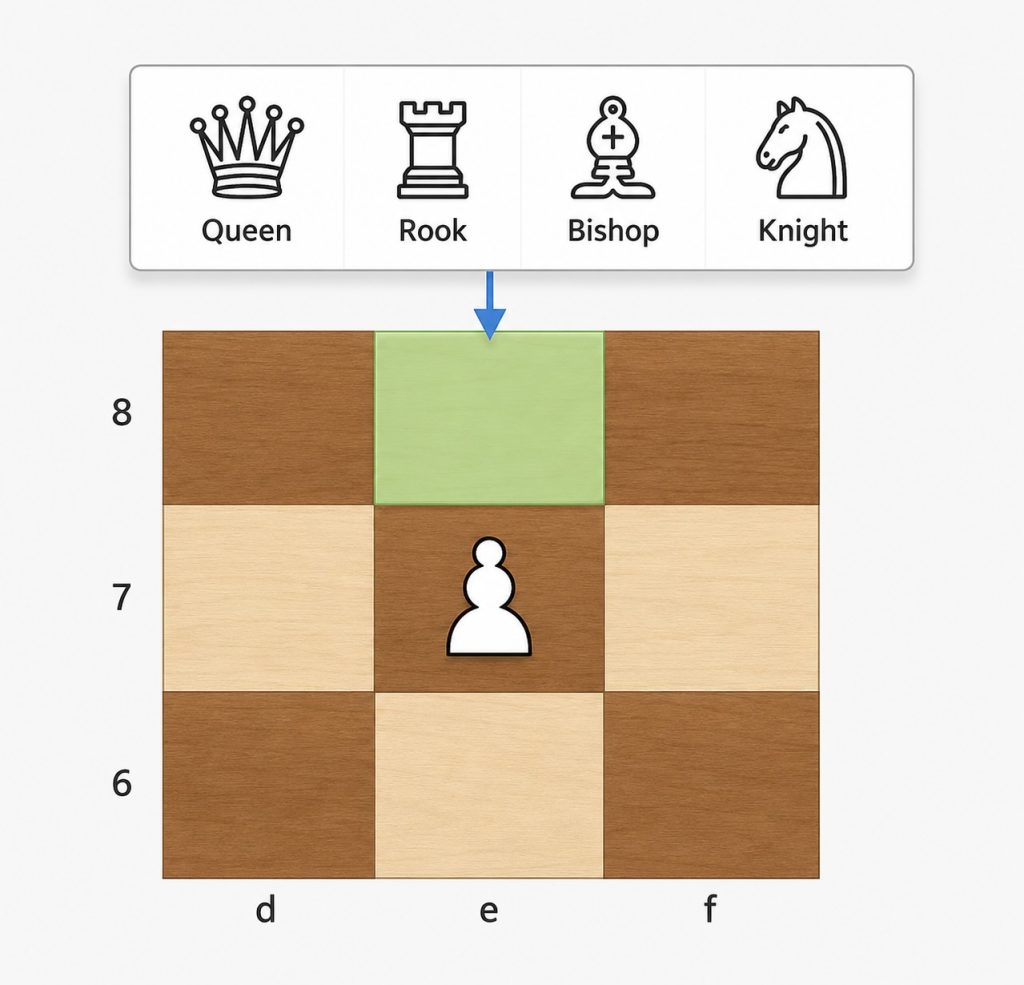
Pawn promotion occurs when a pawn reaches the last rank of the board — rank 8 for White, rank 1 for Black. The moment the pawn arrives on that square, the player must replace it with another piece: a queen, a rook, a bishop, or a knight. The pawn cannot stay as a pawn, and it cannot become a king.
The promotion takes effect immediately. The new piece can give check or checkmate on the very move it appears on the board. There is no waiting, no delay — the transformation is instant.
The Rules of Pawn Promotion
1. The pawn must reach the last rank. Rank 8 for White, rank 1 for Black. A pawn that has not yet reached that rank cannot promote — even if it is one square away.
2. Promotion is mandatory. You cannot choose to leave the pawn as a pawn. Once it reaches the last rank, you must immediately declare which piece it becomes.
3. You can choose any piece except a pawn or king. The four legal choices are queen, rook, bishop, and knight. You can even promote to a second queen if you already have one — there is no limit on how many copies of the same piece you can have on the board.
4. Only pawns can promote. No other piece has this ability. A rook, bishop, or knight that reaches the last rank stays exactly what it is.
Pawn Promotion Notation
In algebraic notation, promotion is recorded as the pawn move followed by the piece it promotes to. The official FIDE notation uses the piece letter directly after the destination square:
a8Q — pawn on the a-file promotes to a queen on a8.
fxe8N — pawn on the f-file captures on e8 and promotes to a knight.
You will also see a8=Q or a8(Q) in some books and software. These formats are widely understood but not officially recognized by FIDE. In over-the-board play, simply state the square and the piece name to avoid any confusion.
Why Almost Everyone Promotes to a Queen
In the vast majority of cases, promoting to a queen is the right choice. The queen is the most powerful piece in chess — it controls more squares than any other piece and can deliver threats along ranks, files, and diagonals simultaneously. A new queen almost always creates an immediate and decisive material advantage.
This is sometimes called queening the pawn. According to data from Lichess, over 98% of all promotions in actual games are to the queen. The other 2% fall into a very specific category: underpromotion.
What Is Underpromotion?
An underpromotion is any promotion to a piece other than a queen. Because the queen is the strongest piece, promoting to a rook, bishop, or knight is considered “under” the maximum — hence the name.
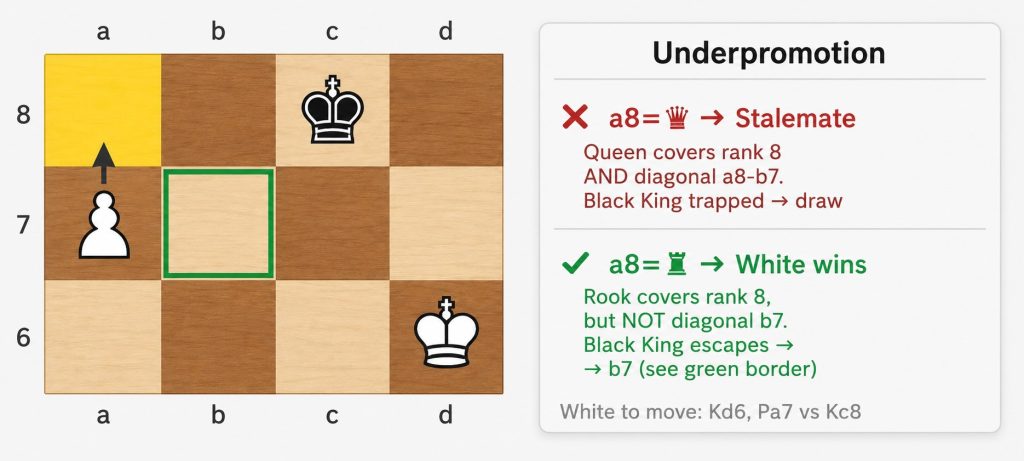
Underpromotion is rare, but it is not a mistake — in the positions where it occurs, it is often the only correct move. There are three main reasons a player would underpromote:
1. To avoid stalemate. If promoting to a queen would leave the opponent’s king with no legal moves — causing a draw — underpromotion to a rook or bishop can win instead.
2. To give a unique check. A knight can reach squares a queen cannot. In some positions, promoting to a knight delivers a fork or checkmate that a queen would not achieve.
3. To gain a tempo. Promoting to a knight with check allows the new piece to immediately harass the opponent’s king or queen, gaining crucial time.
Pawn Promotion Strategy
Create a Passed Pawn
A passed pawn is a pawn with no enemy pawns in front of it or on adjacent files. It is free to advance toward promotion. Creating and advancing a passed pawn is one of the most reliable winning strategies in endgames. The further it advances, the more resources the opponent must commit to stop it.
The Threat Is Often Stronger Than the Promotion Itself
A pawn one or two squares from promotion does not need to promote immediately to be effective. The threat forces the opponent to react — even at the cost of material — while you create opportunities elsewhere. This is a fundamental endgame technique.
King Activity Is Critical
In the endgame, the king becomes an active piece. Getting your king in front of your passed pawn dramatically increases its chances of promoting. Conversely, placing your king in front of the opponent’s passed pawn is the most reliable way to stop it.
Queen vs. Pawn Endgames
If you have a queen and your opponent has a pawn close to promotion, you generally win — but the technique matters. Against a rook, bishop, or knight pawn on the seventh rank, the pawn can sometimes force a draw through stalemate even after the queen stops it.
Famous Pawn Promotion Games
Fischer vs. Taimanov, 1971 — A Passed Pawn That Decided a Match
In the 1971 Candidates Match, Bobby Fischer dominated Boris Taimanov 6–0. Fischer’s endgame technique was clinical — in several games, he converted his advantage through the promotion of passed pawns. The match is a masterclass in how superior pawn play translates directly into wins.
View the full game on 365Chess →
Karpov vs. Timman, Brussels 1986 — The Perfect Underpromotion
Anatoly Karpov reached a position where promoting to a queen would allow Jan Timman to force a perpetual check — a draw. Instead, Karpov promoted to a knight, attacking Timman’s queen and cutting off the perpetual check. Karpov won. It is one of the most celebrated underpromotions in tournament chess history.
View the full game on 365Chess →
Can a Pawn Promote Without Capturing?
Yes. A pawn can promote by advancing straight ahead to the last rank without capturing. It can also promote by capturing diagonally on the last rank — if an enemy piece sits one file away and one rank forward, the pawn captures it and immediately promotes.
Practice Pawn Promotion on 365Chess
The best way to sharpen your promotion technique is to practice endgame positions. The Endgames Training tool lets you practice king-and-pawn vs. king positions and more complex endings against the computer. You can also set up specific positions using the Analysis Board and experiment with different promotion choices.
For a complete foundation in the rules, see our guides on en passant, castling, and how to set up a chess board.
Frequently Asked Questions
Can you have two queens in chess?
Yes. If you promote a pawn to a queen while already having your original queen on the board, you can have two queens simultaneously. There is no limit on pieces of the same type — in theory you could have nine queens, though this never happens in practice.
Can a pawn promote to a king?
No. The only legal choices are queen, rook, bishop, or knight. There is always exactly one king per side, and no rule allows that to change.
Does promotion have to happen immediately?
Yes. The moment a pawn reaches the last rank, the player must declare which piece it becomes before their turn ends. You cannot leave the pawn on rank 8 and decide later.
What is queening a pawn?
Queening is the informal term for promoting a pawn to a queen — the most common and usually the most powerful promotion choice.
When should you underpromote?
Underpromote when a queen would cause stalemate, when a knight promotion delivers a unique check or fork, or when a knight promotion gains a critical tempo. In all other cases, queening is correct.
Can Black promote a pawn too?
Yes. Pawn promotion works identically for both sides. Black promotes when a pawn reaches rank 1. The rules are exactly the same as for White.