
Castling is one of the most important moves in chess – and one of the most misunderstood. It is the only move that lets you move two pieces at once, protects your king, and activates a rook, all in a single turn. Every chess player needs to understand it.
This guide covers everything: what castling is, exactly how to do it on both sides, all four rules, the notation, and the strategic decisions behind when — and when not — to castle.
What Is Castling in Chess?
Castling is a special move involving the king and a rook. It is unique in three ways: it is the only move in chess where two pieces move at the same time, the only time the king may move more than one square, and the only move that both protects the king and develops a rook simultaneously.
Castling can be performed on two sides of the board: kingside (also called short castling, notated O-O) and queenside (also called long castling, notated O-O-O). The rook is the only piece involved alongside the king — no other pieces participate in the move.
How to Castle in Chess — Step by Step
Kingside Castling (Short Castle — O-O)
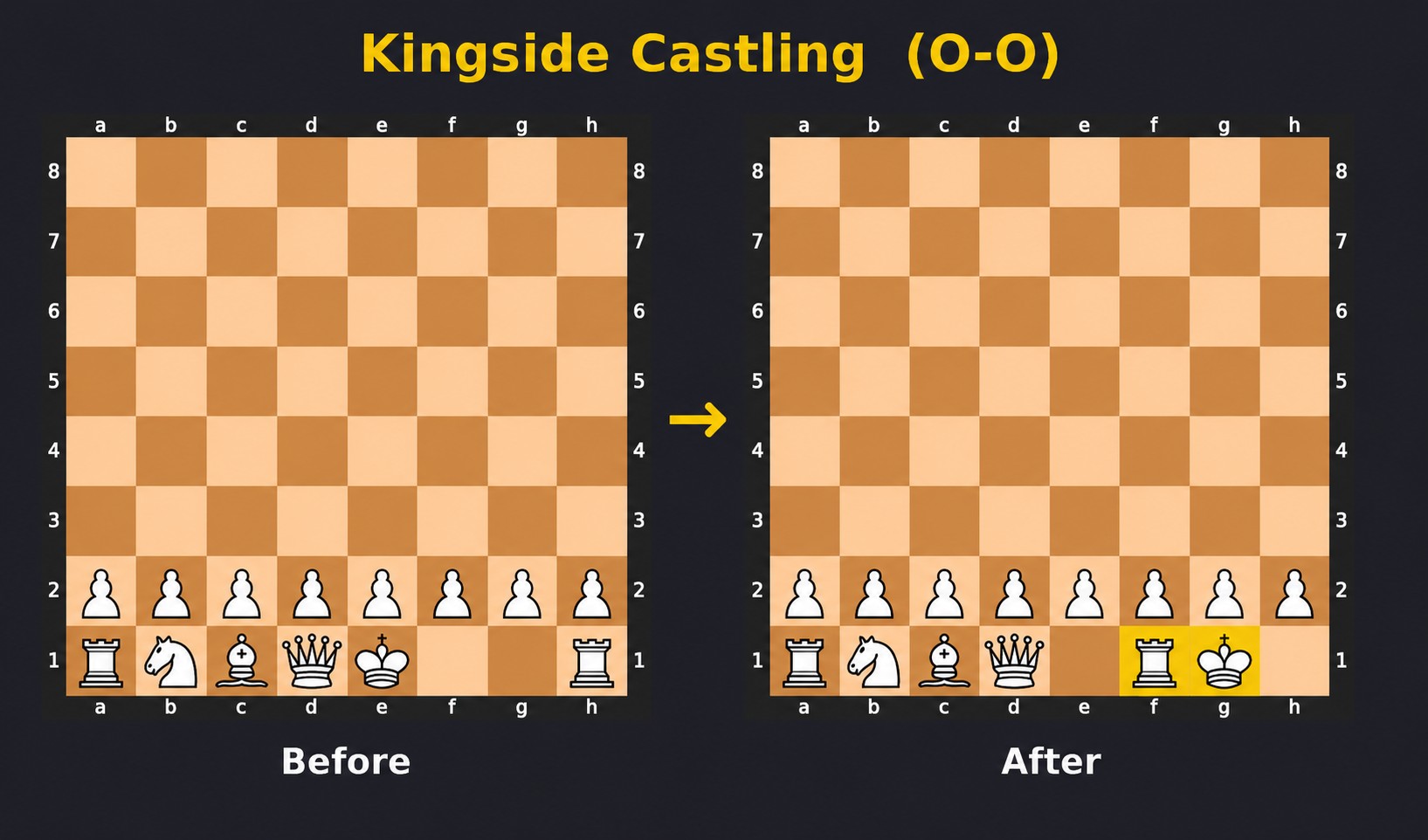
To castle kingside, the king moves two squares toward the h-file rook. The rook then jumps over the king and lands on the square the king just crossed.
For White: the king moves from e1 to g1, and the rook moves from h1 to f1.
For Black: the king moves from e8 to g8, and the rook moves from h8 to f8.
Queenside Castling (Long Castle — O-O-O)
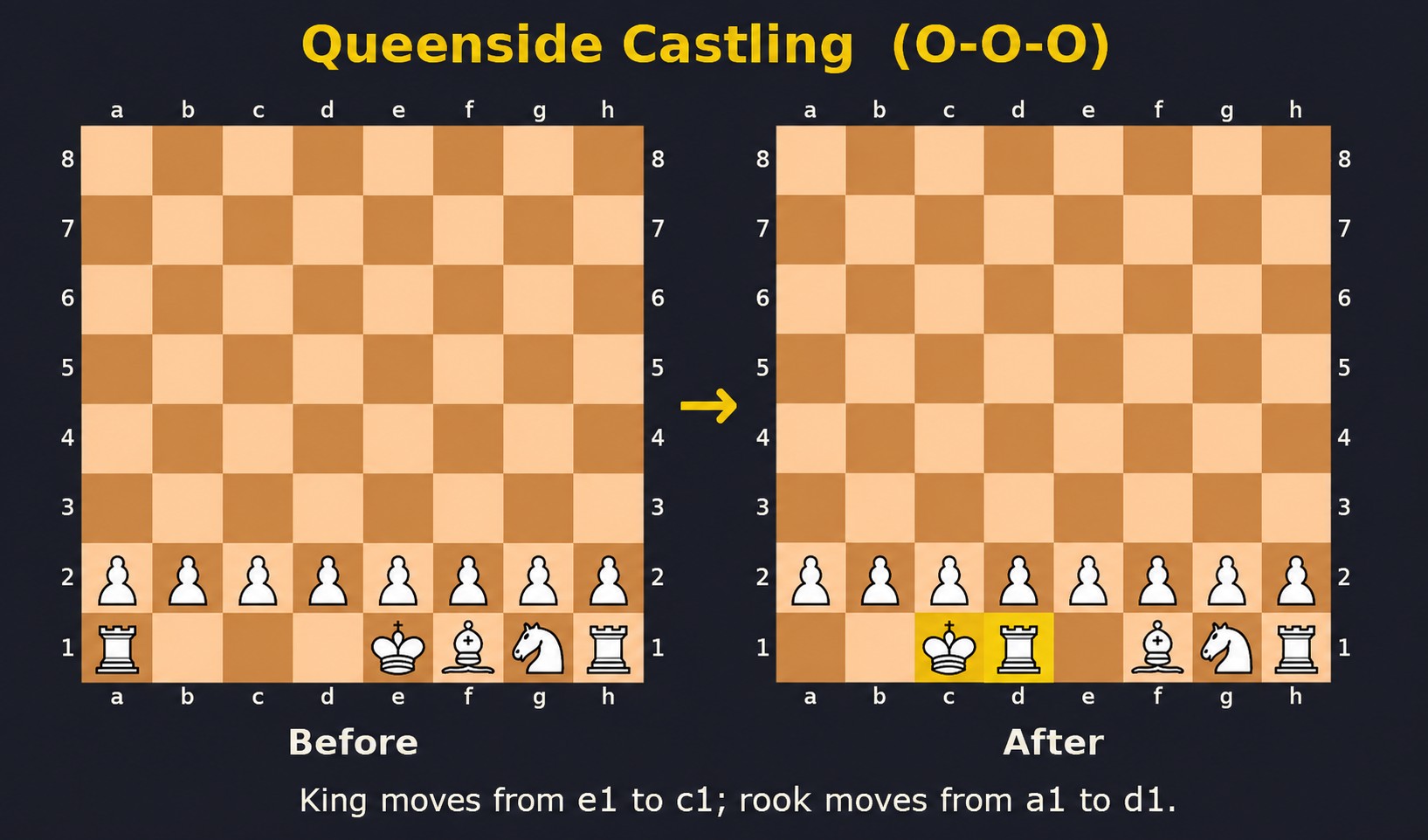
To castle queenside, the king moves two squares toward the a-file. The rook on a1 then jumps over the king and lands on d1.
For White: the king moves from e1 to c1, and the rook moves from a1 to d1. Queenside castling requires three squares to be empty — b1, c1, and d1.
The 4 Conditions for Castling
Castling is only legal when four specific conditions are all met at the same time:
- Neither the king nor the rook has previously moved.
- No pieces stand between the king and the rook.
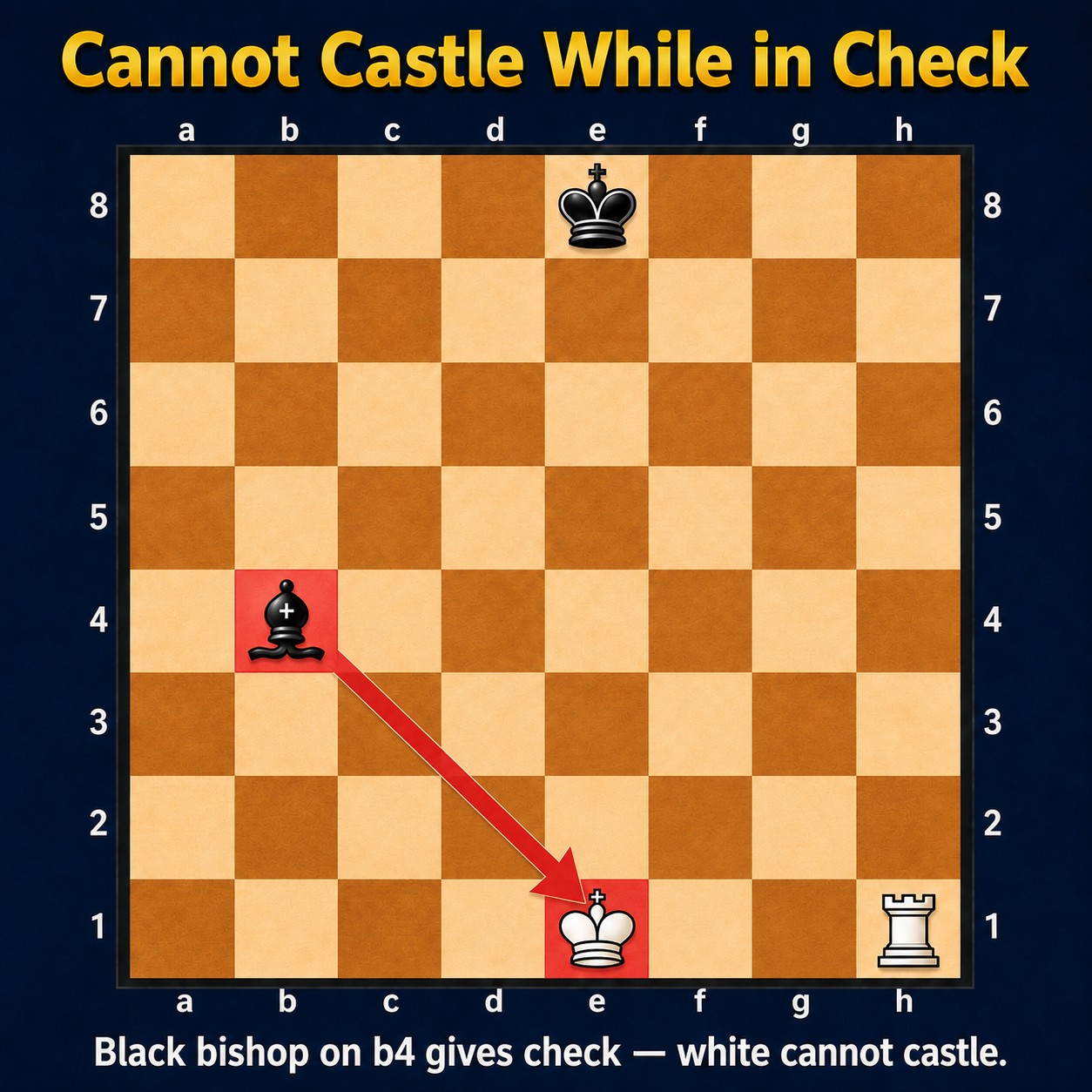
- The king is not currently in check.
- The king does not pass through or land on an attacked square.
You Cannot Castle While in Check
If your king is currently in check, you must deal with the check first — by moving the king, blocking the attack, or capturing the attacker. Castling is not a legal escape from check.
The King Cannot Pass Through or Land on an Attacked Square
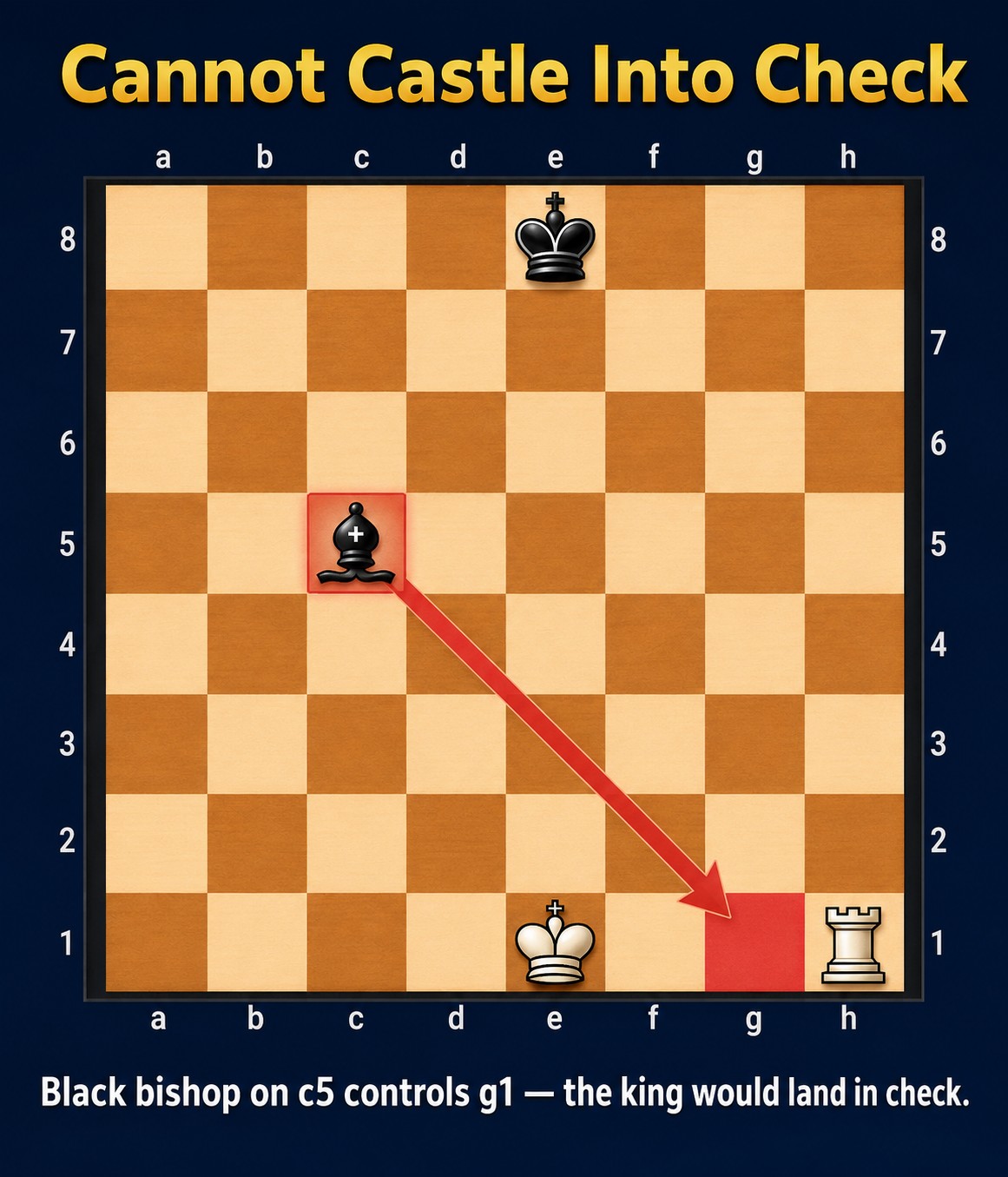
When castling kingside, the king passes through f1 before landing on g1. If either of those squares is controlled by an enemy piece, castling is illegal — even if the king itself is not in check before the move.
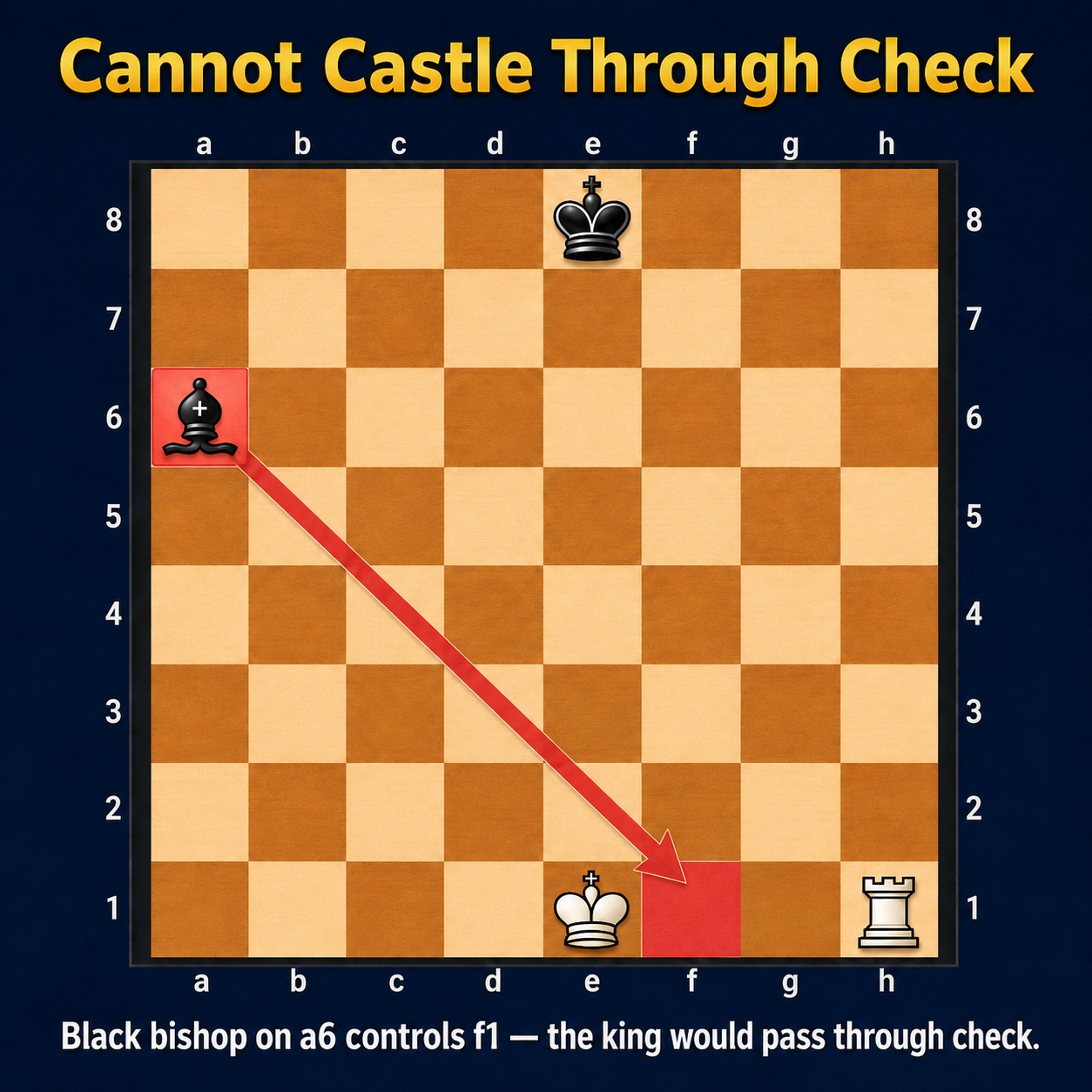
Similarly, the king cannot castle if the destination square is attacked.
Castling Notation: O-O and O-O-O
In chess notation, castling is written with zeros, not the letter O:
- O-O = kingside castling (short castle). The king moves two squares toward the h-file.
- O-O-O = queenside castling (long castle). Three zeros because the king travels further across the board.
When a move results in check, a “+” is added: O-O+. Checkmate would be O-O#.
Why Is Castling Important?
King safety. In the center of the board, your king is exposed to attacks along open files and diagonals. After castling, your king sits behind a wall of pawns on the edge of the board. This dramatically reduces the risk of a quick checkmate. One of the core chess opening principles is to castle early precisely for this reason.
Rook activation. Rooks are most powerful on open files and in the center. Before castling, your kingside rook is trapped behind a row of undeveloped pieces. Castling instantly connects your rooks and brings one of them toward the center of the board.
Most strong players aim to castle within the first 10–12 moves of the game. The goal is to get your king safe while a rook enters play — two objectives achieved with a single move.
Kingside vs Queenside Castling — Which Should You Choose?
Castle kingside (O-O) when: your kingside pawn structure is intact, your opponent’s pieces point toward the queenside, or you want a faster castle — fewer pieces usually need to be cleared.
Castle queenside (O-O-O) when: you plan to launch a pawn storm against your opponent’s kingside-castled king, your queenside is more developed, or you want a sharp game where both sides attack on opposite wings.
When both players castle on opposite sides, the game becomes tactical and aggressive — each player races to attack the other’s king. When both castle on the same side, play is typically more positional and strategic.
When NOT to Castle
When the castled position is already under attack. If your opponent has launched pawns toward your kingside, castling there might walk your king into danger. Consider keeping the king in the center or switching to queenside castling.
When you can win material or deliver a decisive attack instead. Castling costs a tempo. If the position demands an immediate tactical strike, do not waste a move on king safety. Review the key chess tactics to evaluate whether the attack outweighs the need to castle.
When the king is needed in the center for the endgame. In simplified positions with few pieces, the king becomes an active fighting piece. Experienced players often forgo castling and march the king toward the center instead.
When castling exposes your king. If your f-pawn or g-pawn is advanced or missing, castling kingside may open lines against your own king rather than shelter it.
Frequently Asked Questions
Can you castle if the rook is under attack?
Yes. The rook does not need to be safe for castling to be legal. Only the squares the king crosses through and lands on need to be unattacked. You can castle even if the rook is being attacked.
Can you castle queenside if the b1 square is attacked?
Yes. For queenside castling, the king passes through d1 and lands on c1 — only those squares must be safe. The b1 square (which the rook crosses) can be under attack, since the king never moves there.
Can you castle after the rook moved and returned to its starting square?
No. If the rook moved at any point during the game — even if it returned to its starting square — castling rights on that side are lost permanently.
Is castling legal in Chess960 (Fischer Random Chess)?
Yes. The king always ends up on g1/g8 (kingside) or c1/c8 (queenside) — the same final squares as in standard chess — regardless of where the king and rook started. The castling conditions remain the same.
How is castling different from en passant?
Both are special moves with specific conditions that catch beginners off guard. Castling involves the king and rook and is about king safety. En passant involves a pawn capture that can only happen immediately after an opponent’s pawn advances two squares. Both are worth mastering early.
Castling connects two of your most important pieces in a single move. Master the rules, develop your pieces quickly to clear the path, and make castling a consistent part of your opening play. Use the 365Chess Analysis Board to practice castling positions, or explore how grandmasters use it in the Opening Explorer.