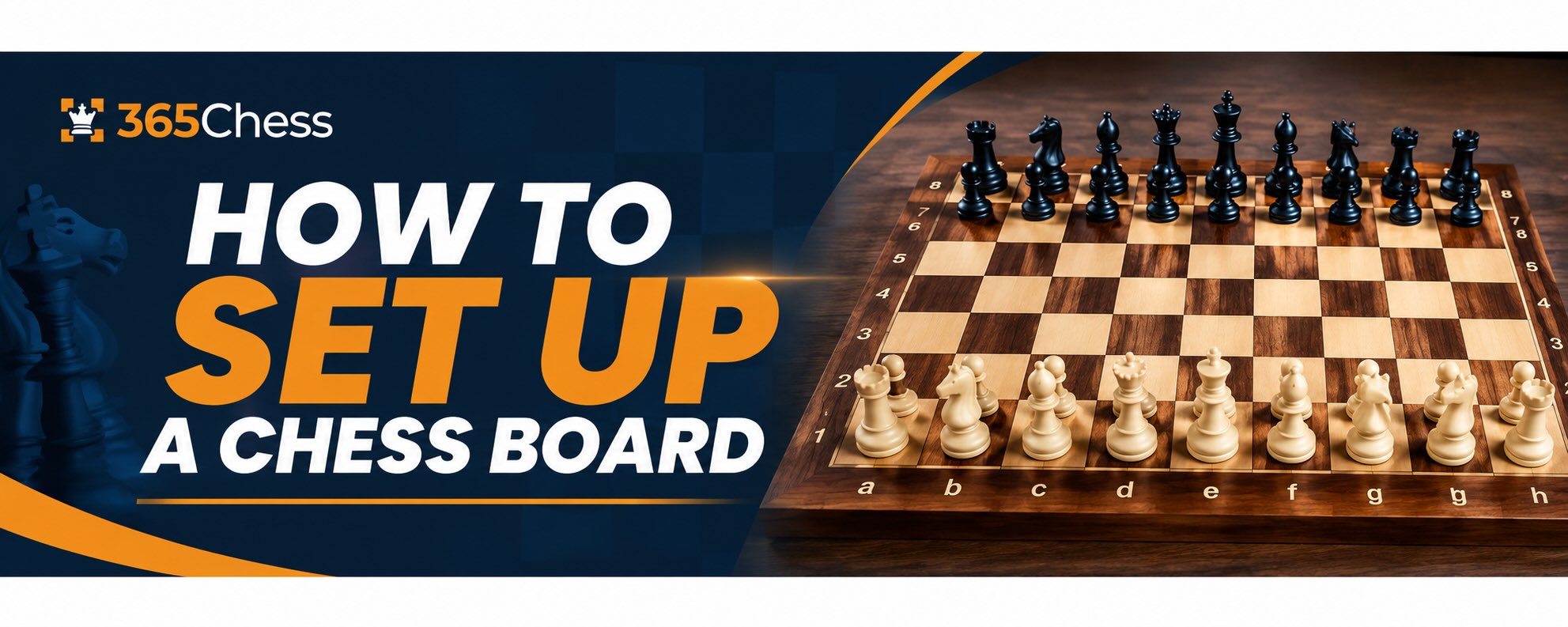
Setting up a chess board correctly takes less than a minute once you know the rules – but getting it wrong is more common than you’d think. A misplaced queen or a backwards board can confuse beginners and even experienced players who learned casually. This guide walks you through every step with clear diagrams so you can set up the board correctly every time.
What You Need
To play chess, you need two things: a chessboard and a set of 32 pieces. The board has 64 squares in an 8×8 grid, alternating between light and dark squares. The pieces are divided equally between the two players — 16 white pieces and 16 black pieces.
Each player starts with: 1 king, 1 queen, 2 rooks, 2 knights, 2 bishops, and 8 pawns. Learn more about what each piece does in our guide to chess pieces: names, values, and moves.
How to Set Up a Chess Board: 7 Steps
Follow these steps in order. Each one builds on the previous, and by the end you’ll have the correct starting position for a game of chess.
Step 1 — Orient the Board Correctly
Before placing a single piece, check the board orientation. The most common setup mistake is placing the board sideways. The rule is simple: each player must have a light-colored square in the bottom-right corner.
If you look at the board from your seat and the bottom-right square is dark, rotate the board 90 degrees. This applies to both players — light square, bottom right, always.
Step 2 — Place the Rooks in the Corners
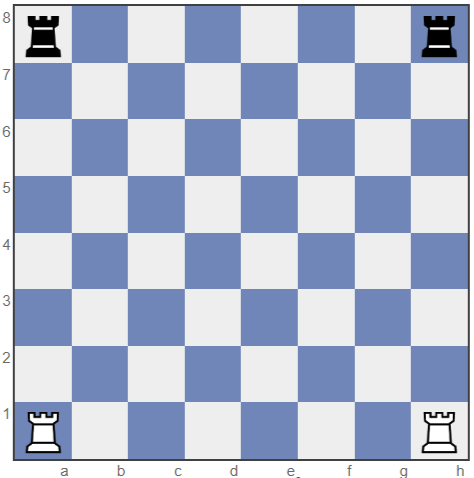
The rooks go in the four corners of the board — one on each side for each player. White’s rooks sit on a1 and h1. Black’s rooks sit on a8 and h8.
Step 3 — Place the Knights Next to the Rooks
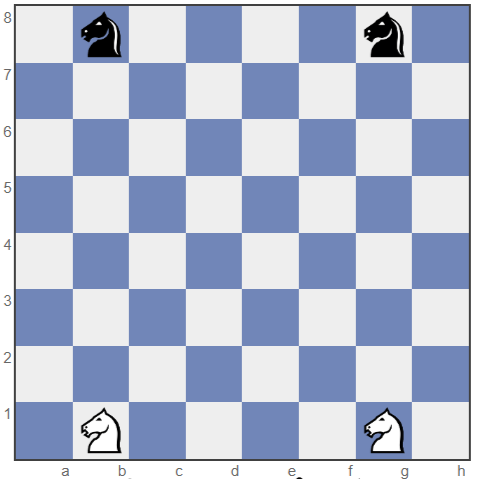
The knights go immediately next to the rooks, on the squares b1/g1 for White and b8/g8 for Black. Each player has two knights.
Step 4 — Place the Bishops Next to the Knights
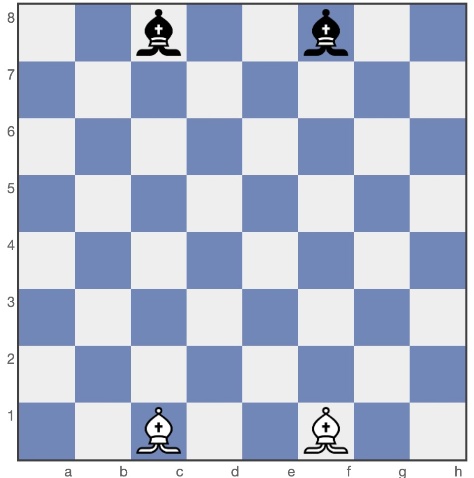
The bishops go next to the knights, on c1/f1 for White and c8/f8 for Black. Notice that one bishop starts on a light square and one on a dark square — that’s by design. Each bishop stays on its starting color for the entire game.
Step 5 — Place the Queen on Her Color
This is the step most beginners get wrong. The queen always goes on a square that matches her own color: the white queen on d1 (a light square), the black queen on d8 (a dark square). An easy way to remember it: “queen on her own color.”

Step 6 — Place the King on the Remaining Square
After the queen is placed, one square remains in the middle of the back row — e1 for White and e8 for Black. That’s where the king goes. The king always ends up next to the queen, on the opposite-colored square.

Step 7 — Fill the Second Row with Pawns
Finally, place all 8 pawns on the second row from each player’s side. White’s pawns go on rank 2 (a2 through h2). Black’s pawns go on rank 7 (a7 through h7). The pawns form a complete line in front of all the other pieces.
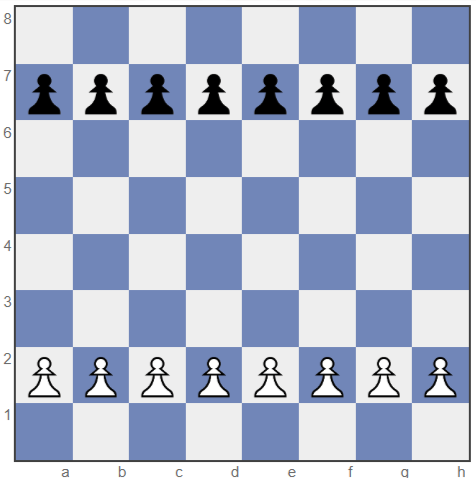
The Complete Starting Position
When all pieces are placed correctly, the board should look like this:

Both back rows are mirror images of each other. The queens face each other across the d-file, and the kings face each other across the e-file. The two rows of pawns create a wall between the armies.
A useful double-check: look at the two queens. The white queen should be on a light square (d1), and the black queen on a dark square (d8). If both queens are on the same color square, something went wrong.
Who Goes First in Chess?
White always moves first. This is a fundamental rule of chess. In casual games, players usually decide who plays white by flipping a coin, rolling a die, or having one player guess which hand hides a pawn. In formal tournaments, the arbiter assigns colors.
Playing white gives a slight advantage because you get to set the tone of the opening. That’s why you’ll often hear experienced players say they prefer playing white. But black has plenty of solid defenses — and many openings have been played at the highest level by both sides for over a century.
After white makes the first move, play alternates: white, black, white, black — until the game ends.
Most Common Chess Setup Mistakes
Board facing the wrong way. This is the most frequent error. If the bottom-right square is dark instead of light, the entire setup is wrong. Rotate the board before placing any pieces.
Queen and king swapped. Beginners often put the king on d1 and the queen on e1 — the opposite of correct. Remember: queen on her own color. White queen on a light square (d1), black queen on a dark square (d8).
Pawns on the wrong row. Pawns belong on the second rank (row 2 for White, row 7 for Black), not the third. Placing pawns on the third row gives you less space and fewer opening options.
Bishops and knights switched. The knights go on b1/g1, and the bishops go on c1/f1 — not the other way around. A knight-bishop swap doesn’t change the board much visually, which makes it an easy mistake to miss.
Practice on 365Chess
The best way to get the starting position into muscle memory is to play. 365Chess has several free tools you can use right away:
Use the Board Editor to set up any position and verify your setup visually. The Play vs Computer tool starts from the correct position automatically, so you can focus on learning the opening moves. If you’re ready to explore what to do after setting up the board, our guide to best chess openings for beginners is the natural next step.
Frequently Asked Questions
Which way does the chess board face?
Each player should have a light-colored square in the bottom-right corner. If the bottom-right square is dark, rotate the board 90 degrees before placing any pieces. This is the single most important orientation rule in chess setup.
Does the queen go on white or black?
Each queen goes on a square that matches her own color. The white queen starts on d1, which is a light square. The black queen starts on d8, which is a dark square. The phrase to remember is: “queen on her own color.”
How many pieces does each player start with?
Each player starts with 16 pieces: 1 king, 1 queen, 2 rooks, 2 knights, 2 bishops, and 8 pawns. Both players together have 32 pieces on the board at the start of the game.
Who moves first in chess?
White always moves first. This is a universal rule in chess. In casual play, players decide who gets white by luck — coin flip, hidden pawn, or any other method. After the first move, players alternate turns for the rest of the game.