A good chess opening is not just a sequence of moves to memorize. It is a way to reach the middlegame with active pieces, control of important squares, a safe king, and a position you understand.
The most important chess opening principles are simple: fight for the center, develop your pieces efficiently, and protect your king. Applying them correctly, however, requires more than following a checklist. You must also recognize threats, avoid wasting time, and understand when the position gives you a concrete reason to break a general rule.
This guide explains ten essential opening principles, the mistakes each one prevents, and the situations in which an exception may be justified.
Table of Contents
- What Are Chess Opening Principles?
- Opening Principles vs. Opening Theory
- The 10 Essential Chess Opening Principles
- When Should You Break Opening Principles?
- Model Game: Opening Principles in Action
- How to Practice Opening Principles with 365Chess
- Final Opening Checklist
- Frequently Asked Questions
What Are Chess Opening Principles?
Chess opening principles are general guidelines that help players make sensible decisions during the first phase of the game.
Unlike opening theory, which tells you which moves have been played in a particular position, opening principles explain what your moves should accomplish.
- Control or challenge the center.
- Develop the minor pieces.
- Keep the king safe.
- Avoid unnecessary weaknesses.
- Coordinate the pieces for the middlegame.
Chess opening principles are general guidelines that help players reach the middlegame with active pieces, control of important central squares, a safe king, and no unnecessary weaknesses.
These principles are especially useful when your opponent plays an unfamiliar move. Instead of trying to remember a variation that may no longer apply, you can evaluate the position and choose a move that improves your development, central control, or king safety.
Opening principles are not laws. Tactics, direct threats, and the concrete demands of the position always come first.
Opening Principles vs. Opening Theory
Opening theory consists of specific move sequences studied through master games, analysis, and practical experience.
For example, after 1.e4 e5 2.Nf3 Nc6 3.Bb5, the position is recognized as the Ruy Lopez. A player who studies the opening may know several theoretical continuations for Black.
Opening principles answer a different question: why do these moves make sense?
- 1.e4 occupies the center and opens lines for the queen and bishop.
- 2.Nf3 develops a piece and attacks the e5-pawn.
- 3.Bb5 develops the bishop and increases pressure on the knight defending e5.
Theory gives you moves. Principles help you understand them.
This distinction matters because memorized moves become less useful as soon as your opponent deviates from your preparation. A player who understands opening principles can still find logical moves in an unfamiliar position.
An opening database can show which moves have been played, how frequently they occur, and the results associated with each continuation. The 365Chess Opening Explorer lets you browse the database move by move and compare the available continuations.
Statistics alone do not tell you why a move works. You must still examine the position, the level of the players, the resulting structures, and the plans behind the move.
The 10 Essential Chess Opening Principles
| Principle | Main purpose |
|---|---|
| Fight for the center | Gain space and piece mobility |
| Develop minor pieces | Bring your army into the game |
| Develop with purpose | Improve the position efficiently |
| Avoid repeated moves | Save valuable tempos |
| Limit unnecessary pawn moves | Avoid weaknesses and lost time |
| Do not expose the queen too early | Prevent attacks with tempo |
| Keep the king safe | Reduce tactical danger |
| Complete development | Coordinate the whole army |
| Respect your opponent’s threats | Avoid playing automatically |
| Attack only when ready | Ensure enough pieces can participate |
1. Fight for Control of the Center
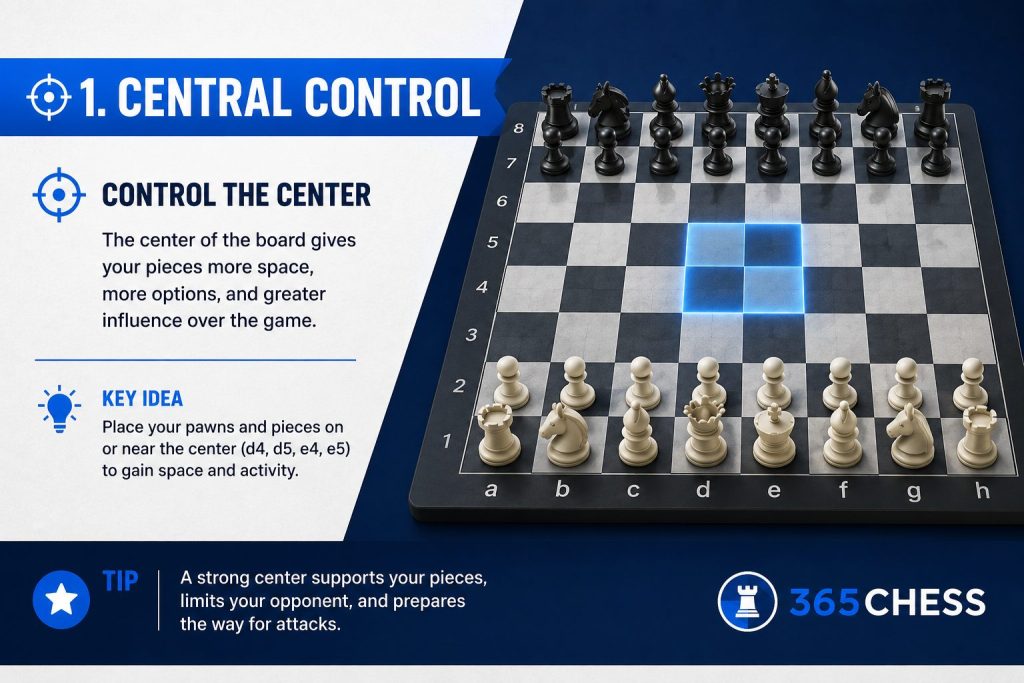
The four most important central squares are d4, e4, d5, and e5.
Controlling these squares gives your pieces more room to move. A knight placed near the center can reach more squares than a knight on the edge, while bishops and queens become more active when central lines open.
The most direct way to influence the center is with pawns. 1.e4 controls d5 and f5, while 1.d4 controls c5 and e5. Black can respond by occupying the center, attacking it, or allowing White to build a pawn center with the intention of challenging it later.
Controlling the center does not always mean occupying it with pawns.
In classical openings, players often place pawns directly on central squares. In hypermodern openings, a player may initially allow the opponent to occupy the center and then attack it with pieces and pawn breaks.
For example, Alekhine’s Defense begins with 1.e4 Nf6. Black invites White to advance the e-pawn and gain space, but plans to attack the extended center later. It may appear to break the rule of immediate central occupation, but it still follows the broader principle of fighting for central control.
Practical question: Does your move control, occupy, or challenge an important central square?
2. Develop Your Minor Pieces Quickly
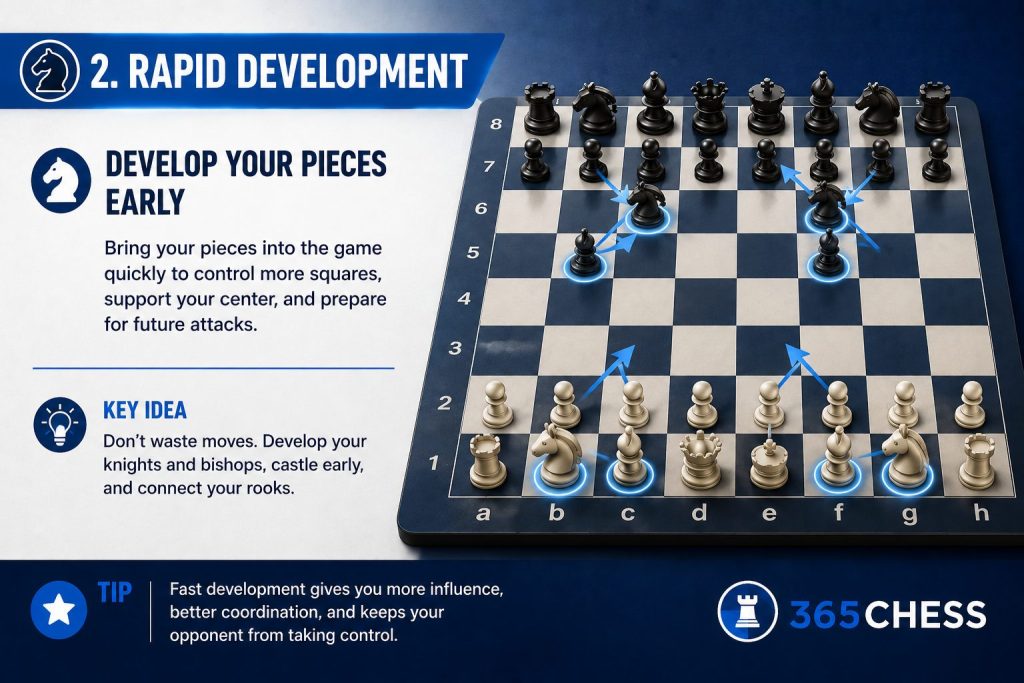
At the beginning of a chess game, most of your pieces cannot participate. The knights and bishops must leave the back rank before the rooks can become fully active.
This is why early development usually focuses on the minor pieces. A natural move such as 1.e4 e5 2.Nf3 develops the knight, attacks the e5-pawn, controls central squares, and brings White closer to castling.
Good development is not simply moving a piece away from its starting square. The piece should move to a square where it performs a useful function. A knight on f3 often controls the center and supports castling. A bishop on c4 may pressure f7. A bishop on b5 may pin or pressure the knight defending e5.
Should knights always be developed before bishops?
“Knights before bishops” is a useful guideline, but not an absolute rule. A knight often has only one or two natural development squares, while a bishop may have several possible diagonals. Developing a knight first can preserve flexibility.
However, there are many positions where the correct bishop square is already clear. In the Italian Game, for example, 1.e4 e5 2.Nf3 Nc6 3.Bc4 develops the bishop immediately because c4 is an active and logical square.
Myth: Knights must always be developed before bishops.
Reality: Develop the piece whose best square is useful and reasonably clear.
3. Develop with Purpose and Tempo
Not every developing move is equally valuable. The strongest opening moves often improve your position while doing something else.
- Attacking an enemy piece.
- Defending an important pawn.
- Preparing castling.
- Controlling a central square.
- Preventing the opponent’s plan.
This is called developing with tempo or developing with purpose. After 1.e4 e5 2.Nf3, White develops the knight while attacking e5, so Black must consider how to defend or support that pawn.
A move can be technically developing but still inefficient. A bishop placed on a square where it is immediately attacked may have to move again. A knight developed to a passive square may block another piece or fail to influence the center.
Before developing a piece, ask what squares it will control, whether it will be stable, whether it helps you castle, and whether your opponent can attack it while developing.
4. Avoid Moving the Same Piece Repeatedly
Every move in the opening is a chance to activate another piece, improve central control, or secure the king. When you move the same piece several times without a concrete reason, your opponent may gain a lead in development.
Consider a player who develops a knight, moves it forward to attack a pawn, and then retreats it after the opponent attacks it. The knight has consumed three moves while the rest of the army remains on the back rank.
Those moves are known as tempos. Losing one tempo is not always disastrous, but repeatedly spending time on one piece may allow the opponent to complete development, castle first, open the center, or gain the initiative.
When is moving the same piece again justified?
- The piece is attacked.
- You can win material.
- You can create a forcing threat.
- The move is part of a sound theoretical variation.
- The position has changed and the piece needs a better square.
- A tactical sequence takes priority over normal development.
Do not spend several moves on one piece unless the result justifies the time invested.
Quick exercise
White has developed the knight from g1 to f3, then to g5, and finally back to f3. The bishop on f1, bishop on c1, and knight on b1 have not moved. What should White usually prioritize next?
The most likely answer is not another knight move. White should look for a useful developing move such as Bc4, Bb5, Nc3, or a move that prepares safe castling, depending on the position.
5. Do Not Make Unnecessary Pawn Moves
Pawn moves are essential in the opening. They control space, open lines, support pieces, and challenge the opponent’s center. But pawns cannot move backward.
Every pawn move creates a permanent change in the position. It may leave a weak square, expose the king, or reduce the flexibility of the pawn structure. This is why unnecessary pawn moves can be especially costly during development.
- e4 controls the center and opens lines for the queen and bishop.
- d4 claims central space and activates the dark-squared bishop.
- c4 may challenge a central pawn or support a space advantage.
- h3 can prevent a pin, but may be a wasted move if there is no immediate purpose.
- f3 may support e4, but it blocks the knight’s natural square and weakens the king.
The problem is not the number of pawn moves alone. The important question is whether those moves contribute to development, central control, or a concrete plan.
Practical question: What permanent change does this pawn move create, and is that change useful?
6. Do Not Bring the Queen Out Too Early—Without a Reason
The queen is the most powerful piece, but that does not mean it should be the first piece to enter the game. Because the queen is so valuable, an opponent can often attack it with a knight, bishop, or pawn. Each attack may force the queen to move again while the opponent develops with tempo.
A common beginner pattern is 1.e4 e5 2.Qh5. White attacks e5 and threatens ideas against f7. The move is not immediately losing, but the queen may become a target. Black can respond with developing moves that defend the position and attack the queen.
The danger is not simply that the queen is developed early. The danger is that its exposure allows the opponent to gain time.
The Scandinavian Defense: a legitimate exception
The Scandinavian Defense begins with 1.e4 d5 2.exd5. One important continuation is 2…Qxd5. After 3.Nc3, White attacks the queen while developing a knight.
Why is the opening still playable? Black has a concrete strategic justification: the center is challenged immediately, the pawn is recovered, the queen has established retreat squares, and the resulting positions are well studied. Black accepts the loss of a tempo in exchange for a clear structure and practical setup.
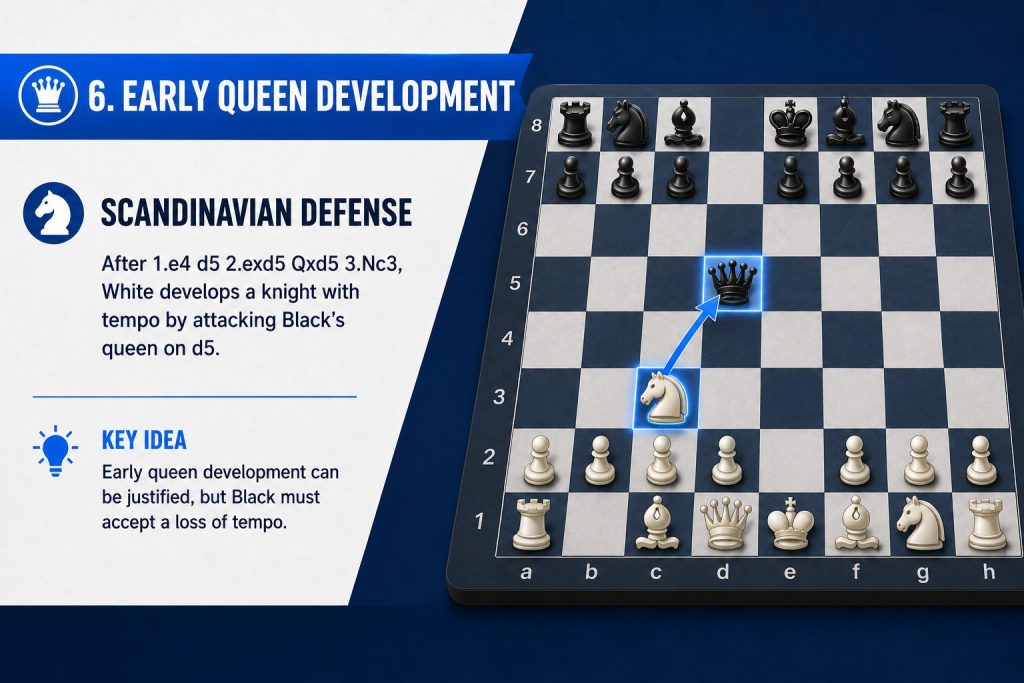
The Scandinavian Defense is a good reminder that opening principles are guidelines. Early queen development is dangerous when it has no purpose or when the queen can be chased without compensation. It is not automatically a mistake.
7. Keep Your King Safe
Many players learn the rule “castle early.” A more accurate principle is: make your king safe before the position becomes dangerous.
Castling is usually the best way to do this because it moves the king away from the center, activates a rook, helps connect the rooks, and reduces the danger of central files opening with the king exposed.
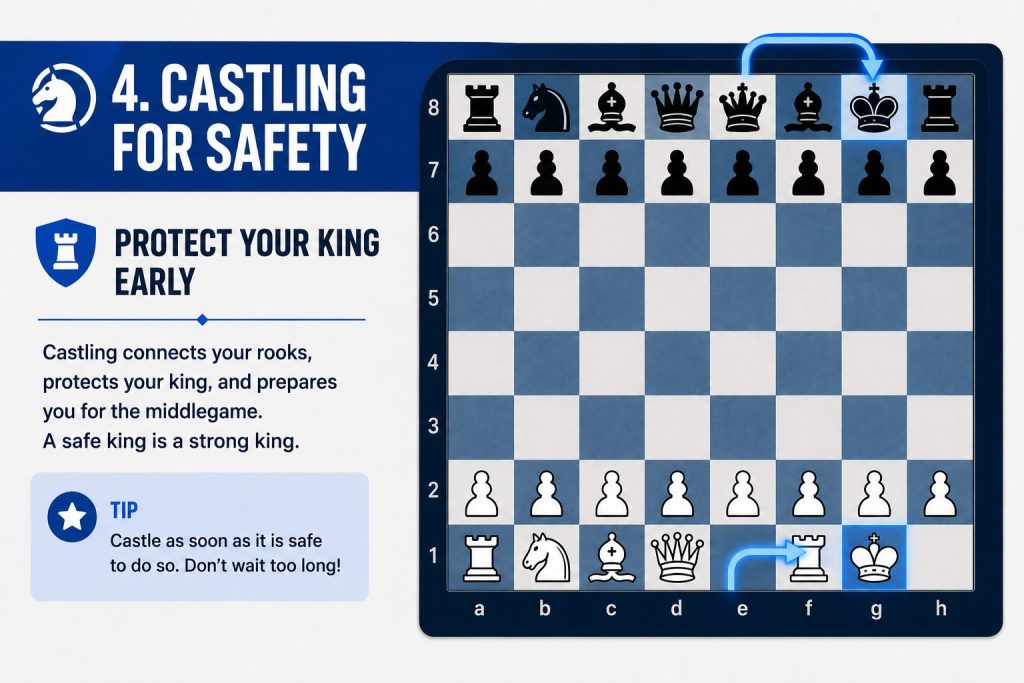
However, castling is a method, not the final objective. There are positions where immediate castling is unnecessary or dangerous:
- The center is completely closed.
- Queens have already been exchanged.
- The opponent has a strong attack on the side where you intend to castle.
- Your king is temporarily safer in the center.
- You need to answer an immediate tactical threat.
A miniature warning: Réti vs. Tartakower
Réti–Tartakower, Vienna 1910, is a memorable example of what can happen when development and king safety are neglected. Black won a pawn but left the king in the center and failed to complete development. White’s pieces entered the game with tempo, and the exposed king became the target of a forced mating combination.
View the complete Réti–Tartakower game on 365Chess
The lesson is not that taking a pawn is always wrong. It is that material becomes less important when the king is exposed and the opponent’s pieces are active.
8. Complete Development and Connect Your Rooks
Many players believe development is complete once they have moved two minor pieces and castled. It is not.
- Active minor pieces.
- A safe king.
- A queen that no longer blocks the rooks.
- Rooks that can support each other.
- Pieces coordinated around a clear plan.
Rooks begin the game trapped in the corners. They become much more effective when the back rank is cleared and they can occupy open or semi-open files.
Connecting the rooks means removing the pieces between them, usually by developing the minor pieces, moving the queen, and castling. This does not mean the queen should move only for the sake of connecting the rooks. It means that completing development should eventually allow all the pieces to work together.
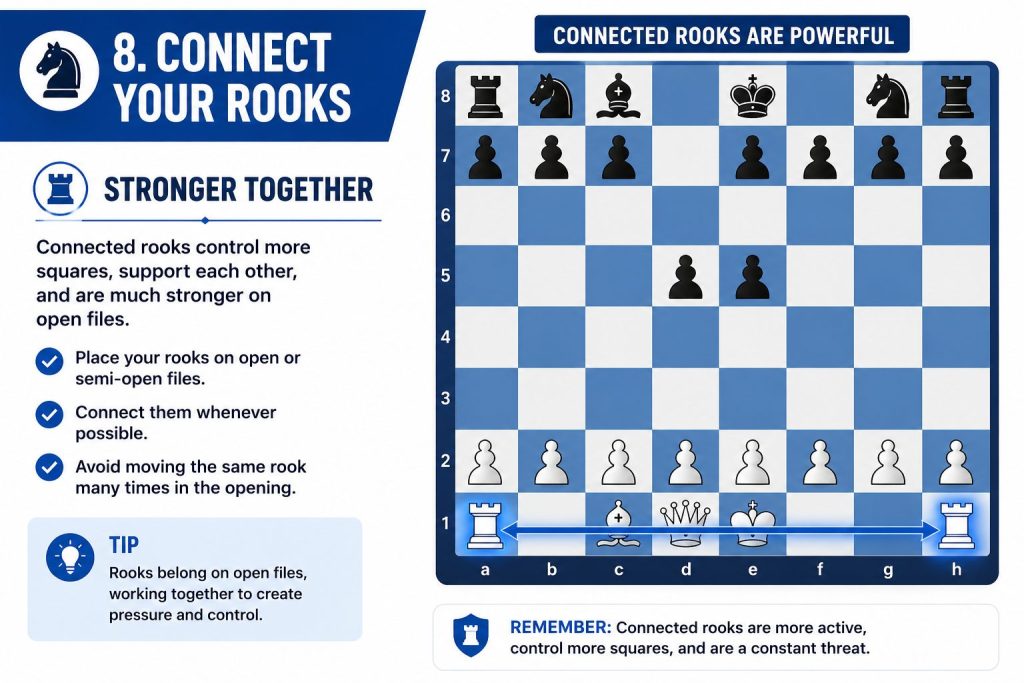
A rook usually belongs on an open file, a semi-open file, a central file that may open, or a file that supports a planned pawn break.
9. Watch Your Opponent’s Threats
Opening principles are useful, but they do not replace calculation. A move may look ideal because it develops a piece, controls the center, and prepares castling. If it ignores a direct threat, it may still lose immediately.
Before making a routine opening move, check:
- Is my king in check?
- Is one of my pieces attacked?
- Is my opponent threatening checkmate?
- Is there an undefended piece?
- Can my opponent make a forcing capture?
- Did the opponent’s last move create a tactical threat?
A useful thinking habit is to examine checks, captures, and threats for both players before returning to general strategic ideas.
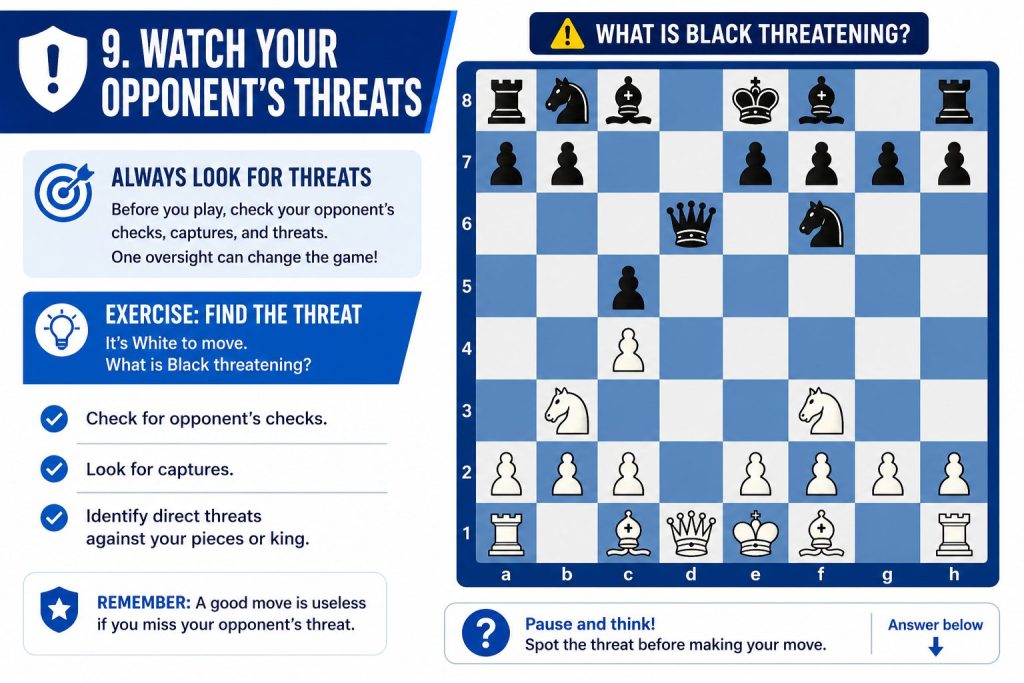
Many openings have familiar development patterns. That can be helpful, but it can also become dangerous when a player stops looking at the board. Your opponent’s move may attack a piece, prevent castling, change the pawn structure, threaten a tactic, or make your usual development square unsafe.
Use opening knowledge as a guide, not as permission to play without thinking.
10. Do Not Attack or Grab Pawns Before You Are Ready
An attack is most effective when several pieces can participate. A player who begins an attack with only a queen and one bishop may discover that the opponent can defend while developing. The attacking pieces then become targets, and the initiative disappears.
Before starting an attack, compare the number of pieces involved:
- How many of your pieces can join quickly?
- How many defenders does the opponent have?
- Is the center stable?
- Is your own king safe?
- Are your undeveloped pieces preventing reinforcement?
- What happens if the opponent opens the center?
The same principle applies to grabbing pawns. Winning a pawn may be attractive, but capturing it can move the queen repeatedly, delay castling, open lines against your king, place a piece far from the action, or allow the opponent to gain development with tempo.
A pawn is valuable, but time and activity can be more important during the opening.
If the center opens now, which side benefits?
When Should You Break Opening Principles?
A strong chess player does not follow opening principles blindly. The principles describe what is usually useful. They do not override tactics or the specific features of a position.
You may have a valid reason to break a principle when:
- A forcing tactical sequence wins material or gives checkmate.
- You must respond to an immediate threat.
- Moving the same piece again creates a concrete gain.
- Established opening theory supports the move.
- The center is closed and the king is not in immediate danger.
- Queens have been exchanged.
- An early queen move has a safe and useful purpose.
- A flank pawn move prevents an important enemy plan.
- Delaying castling keeps your options open.
- A temporary loss of time produces a lasting positional benefit.
The stronger the exception, the more concrete the justification should be.
“I hope this move creates an attack” is not a concrete justification. “This move wins a piece by force” is.
Before breaking an opening principle, ask:
- What immediate problem does this move solve?
- What happens if I continue normal development?
- Can my opponent attack this piece and gain time?
- Does the move weaken my king?
- Am I relying on a tactic that actually works?
- Is this move supported by theory or by the demands of the position?
- What compensation do I receive for the time or structure I give up?
Principles are most useful when they improve your decisions. They become harmful only when they replace calculation.
Model Game: Opening Principles in Action
Paul Morphy’s famous game against the Duke of Brunswick and Count Isouard in Paris in 1858 is one of the clearest demonstrations of rapid development, central play, king safety, and coordinated attack.
View the complete Opera Game on 365Chess
Fight for the center
After 1.e4 e5 2.Nf3 d6 3.d4, Morphy immediately challenges the center. Black’s second move supports e5, but it also blocks the bishop on f8. White uses the opportunity to open the position before Black completes development.
Develop with threats
Moves such as 6.Bc4, 7.Qb3, 8.Nc3, and 9.Bg5 bring White’s pieces into the game while placing pressure on Black’s position. Black is repeatedly forced to respond instead of completing development.
Open the position when the enemy king is exposed
With Black’s king still in the center, Morphy uses 10.Nxb5! to open lines. The sacrifice is possible because White has more active pieces and can bring them into the attack immediately.
Castle to activate the rook
After 12.O-O-O, castling does more than protect the king. It places a rook directly on the open d-file, where it joins the attack.
Use every active piece
The final combination works because White’s queen, bishops, and rooks are coordinated. Morphy sacrifices material only after development and activity have created a concrete tactical opportunity.
The Opera Game is not a lesson in sacrificing pieces at every opportunity. It is a lesson in how development, central control, king safety, and coordination make tactical sacrifices possible.
How to Practice Opening Principles with 365Chess
Understanding opening principles requires more than reading them. You need to recognize them in real positions and compare your decisions with games played by experienced players.
The 365Chess Opening Explorer lets you move through the chess database one move at a time and examine the continuations played from each position.
1. Enter the opening moves from one of your games
Start from the initial position and reproduce the moves you played. Do not immediately look for the engine’s preferred move. First identify the opening principles involved.
- Who controls more of the center?
- Which pieces have been developed?
- Are both kings safe?
- Has either player wasted time?
- Are there immediate threats?
2. Find the first unfamiliar position
Move through the game until you reach the point where you no longer knew what to do. Studying that decision is usually more useful than memorizing a long sequence from move one.
3. Compare the common continuations
Look at the moves played in master games, but do not automatically choose the move with the highest winning percentage. A percentage can be influenced by the rating of the players, the number of games, the positions reached, historical trends, and the quality of the opposition.
Use database statistics as a starting point for investigation, not as a replacement for analysis.
4. Open two or three model games
Choose games played by strong players and observe where the pieces were developed, how the center was handled, when each player castled, which pawn breaks were prepared, and how the game moved from the opening to the middlegame.
You do not need to memorize every move. Try to understand the recurring setup and plans.
5. Explain the position in your own words
Before turning on an engine, write or say a short explanation of the position. For example: “White has more central space, but Black plans to attack the center with …c5. White should complete development and avoid advancing more pawns without a reason.”
6. Use the Analysis Board after your own review
Once you have identified the strategic ideas, use the 365Chess Analysis Board to check tactics and compare candidate moves.
The engine can show that a move is inaccurate, but your goal is to understand the human reason behind the mistake. Did the move ignore a threat, lose a tempo, weaken the king, block development, allow a central break, or place a piece on an unstable square?
You can also reinforce the positions you study with the Chess Openings Trainer.
Final Opening Checklist
Before playing an opening move, ask:
- Is there an immediate check, capture, or threat?
- Is my king safe?
- Am I controlling or challenging the center?
- Which undeveloped piece needs to enter the game?
- Does this move improve my position with tempo?
- Am I moving the same piece unnecessarily?
- Does this pawn move create a permanent weakness?
- Can my queen become a target?
- Can I complete development and connect my rooks?
- Am I attacking before enough pieces are ready?
- Is there a concrete reason to break a general principle?
You do not need to answer every question before every move. With practice, these ideas become part of your natural decision-making process.
Frequently Asked Questions
What are the three most important opening principles in chess?
The three most important opening principles are central control, piece development, and king safety. Most other opening guidelines support one of these priorities. Good pawn moves influence the center, good developing moves activate the pieces efficiently, and castling usually protects the king while bringing a rook into play.
What is the number one rule of a chess opening?
There is no single rule that applies to every opening position. A strong practical default is to develop your pieces efficiently while paying attention to your opponent’s threats. A move that develops a piece, improves central control, and helps protect the king is usually more valuable than a move with no immediate purpose.
Should knights always be developed before bishops?
No. Knights are often developed first because their best squares are usually easier to identify. Bishops may have several possible diagonals, so delaying their development can preserve flexibility. However, when a bishop has an obvious and useful square, developing it before the second knight may be completely correct.
Is it always bad to move the queen early?
No. Early queen development becomes a problem when the opponent can attack the queen while developing pieces and gaining time. Some sound openings, including variations of the Scandinavian Defense, bring the queen out early for a concrete reason. The important question is whether the queen is useful and reasonably safe.
Should you always castle early?
You should aim to make your king safe, and castling is usually the most efficient method. However, castling may be delayed when the center is closed, queens have been exchanged, or castling would move the king into an attack. King safety is the objective; castling is one way to achieve it.
When can you break an opening principle?
You can break an opening principle when the position gives you a concrete tactical, strategic, or theoretical reason. Examples include winning material, answering a direct threat, creating a forced attack, preventing an opponent’s plan, or following a well-established variation. The exception should have a clear justification.
How many opening moves should a beginner memorize?
A beginner usually benefits more from understanding the typical setup, plans, pawn structure, and opening principles than from memorizing long variations. Learn enough moves to reach a familiar position, then study model games and understand what each side is trying to achieve.
How can I tell when the opening is over?
There is no fixed move when the opening ends. The game usually enters the middlegame when most pieces have been developed, the kings are reasonably safe, and the players begin executing plans based on the pawn structure and piece placement.
Put the Principles into Practice
Opening principles give you a reliable way to make decisions when you do not know the exact theory. Fight for the center, develop your pieces efficiently, keep your king safe, and avoid wasting time. At the same time, remain alert to tactics and direct threats. A general rule should never prevent you from playing a move that the position clearly requires.
The goal is not to follow every principle mechanically. It is to understand what each principle is trying to achieve.
Use the 365Chess Opening Explorer to study positions from your own games, compare master continuations, and find model games that demonstrate the plans behind your openings. The more positions you examine, the easier it becomes to recognize when a principle applies—and when the position demands an exception.
Players who are still choosing their first repertoire can continue with our guide to the best chess openings for beginners. For a broader understanding of planning beyond the opening, read our guide to chess strategy.