King’s Indian Defense with IM Marcin Sieciechowicz
$129.00
What You Will Get in this Course

Video Lessons
This Course contains video lessons to guide you through its content.
Lessons' PGNs
Browse or download, with a beautiful and intuitive tool, the PGN files of the lessons in this course.
365Chess Coach
Learning chess has never been so fun and effective! Go from theory to practice, step-by-step, guided by the Chess Coach.Repertoire Trainer
Study, analyze or drill the repertoire in the course. Play one side while the computer replies with the moves on the theory.
Games Database
This course includes a database of chess games played by masters to see the theory "in action".Risk Free Purchase
90 Days Refund Guarantee
If for any reason you are not absolutely happy with the Course, we will refund the full amount of your purchase back to you. No questions asked!

Summary
Course Outline
- Chapter 1. Illustrative Games
- Chapter 2. Rarely Played Lines
- Chapter 3. Rarely Played Lines Games
- Chapter 4. Averbakh System
- Chapter 5. Averbakh System Games
- Chapter 6. Samisch System
- Chapter 7. Samisch System Games
- Chapter 8. Four Pawns System
- Chapter 9. Four Pawns System Games
- Chapter 10. Fianchetto System
- Chapter 11. Fianchetto System Games
- Chapter 12. Exchange System
- Chapter 13. Exchange System Games
- Chapter 14. Gligoric System
- Chapter 15. Gligoric System Games
- Chapter 16. Petrosian System
- Chapter 17. Petrosian System Games
- Chapter 18. Bayonet Attack
- Chapter 19. Bayonet Attack Games
- Chapter 20. 9.Ne1 and 9.Nd2 systems
- Chapter 21. 9.Ne1 and 9.Nd2 systems Games
Learn the King’s Indian Defense with IM Marcin Sieciechowicz
The engines do NOT understand this opening. Why?
- Black allows White to build up his center advantage
- Black fianchettoes his bishop and blocks it with e5-pawn
- Black shuffles pieces to give White gain in tempi.
It surely goes against common sense, right?
Then why do so many of the world’s greatest players choose the King’s Indian?
Tal, Fischer, and Kasparov — we call them GOAT!
More recently, Nakamura, Svidler, Radjabov, and Ding Liren. (Again 2700+ players in question.)
And they win. Consistently… and often spectacularly.
What’s the mystery here? It’s because the King’s Indian Defense is like a coiled cobra ready to strike at a moment’s notice… landing a nasty bite on the enemy king, and White would end up paralyzed to “death”.
But to play it, you need to learn it.
That’s where IM Marcin Sieciechowicz’s 10 hour video training that unravels this beautiful opening for you in all its glory.
Starting from the Petrosian system to the Averbakh system to the Bayonet Attack, he takes each variation and decodes it move by move.
Here’s what you would learn:
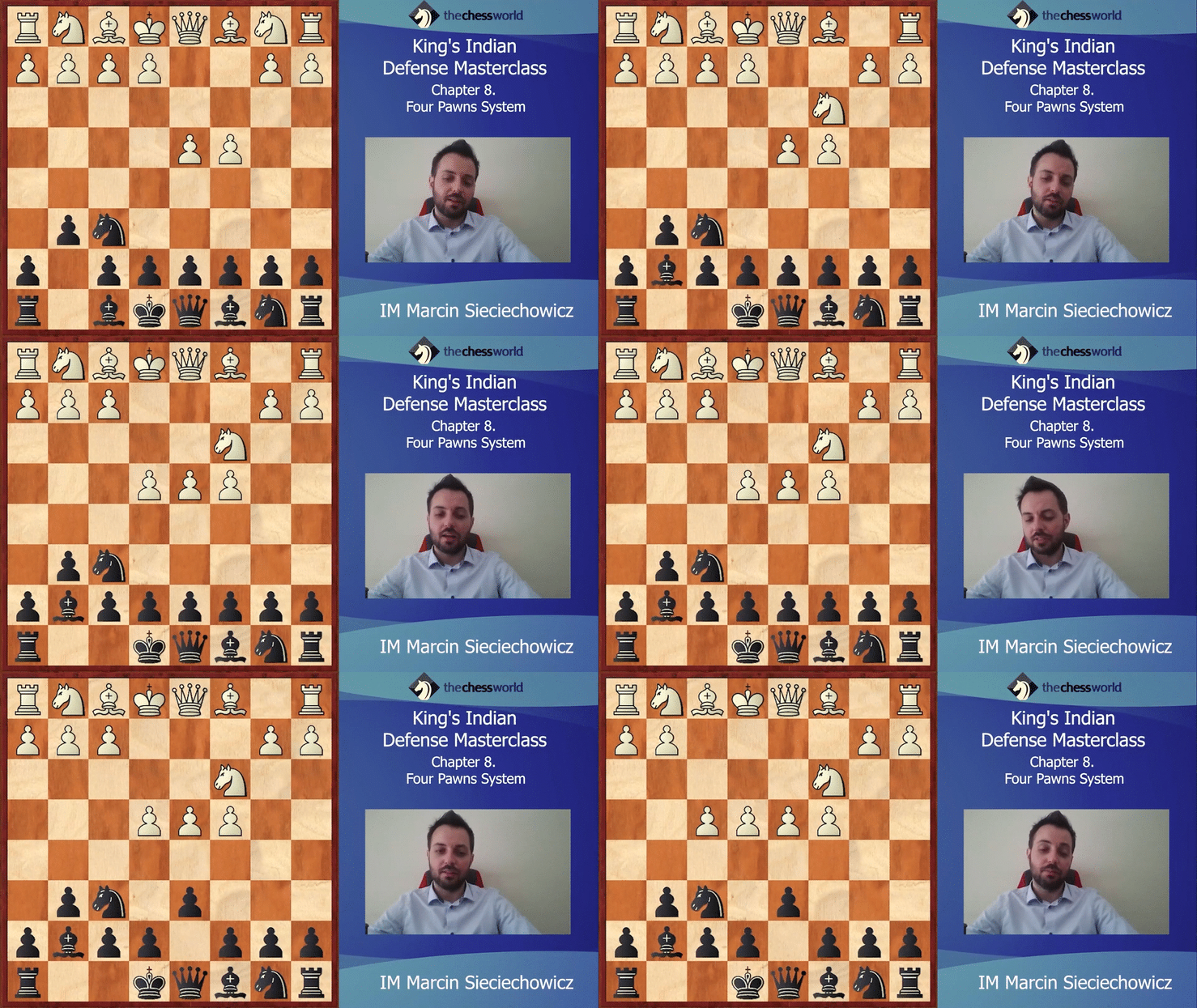
- Four pawns attack. White intends to push the f-pawn forward. Without hiding his intentions, he goes for it. Very sharp, and totally open position! Learn how to play it as Black.
- Kingside attack in Samisch. Ponomariav, as Black, pushed the h-pawn forward against Tomashevsky. Was that a mistake? Or, the Nge5 move was a little dicey? Let Sieciechowicz tell you.
- Central lock in Petrosian. Learn how Kasparov went for a flank attack instead and rolled over White’s king protection. Piece by piece, move by move… with a dark square bishop exchange.
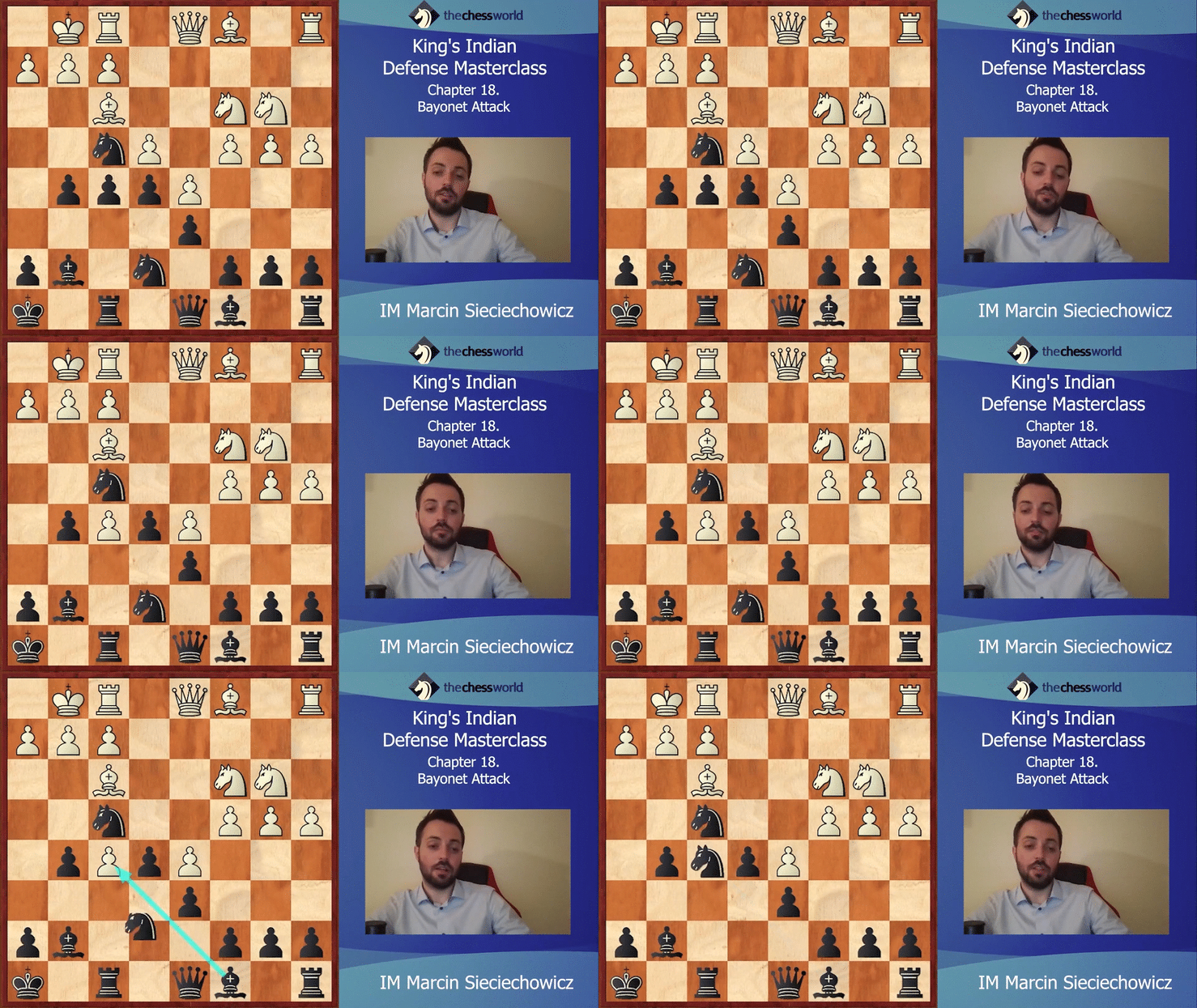
- Opposite castling. White usually goes for full-on action. Tough to handle when all those kingside pawns are heading towards your king. See how Nakamura does it against Rodshtein.
- No central lock? A tough position to handle—the dark-square bishop gains control of the long diagonal but White is far ahead in development. Does Black have any play? If yes, how?
Training:
365Chess Coach will take you through this course step by step! Utilize our unique tool and cut your learning time in half, practicing as you go!
Outline:
Chapter 1. Illustrative Games
Chapter 2. Rarely Played Lines
Chapter 3. Rarely Played Lines Games
Chapter 4. Averbakh System
Chapter 5. Averbakh System Games
Chapter 6. Samisch System
Chapter 7. Samisch System Games
Chapter 8. Four Pawns System
Chapter 9. Four Pawns System Games
Chapter 10. Fianchetto System
Chapter 11. Fianchetto System Games
Chapter 12. Exchange System
Chapter 13. Exchange System Games
Chapter 14. Gligoric System
Chapter 15. Gligoric System Games
Chapter 16. Petrosian System
Chapter 17. Petrosian System Games
Chapter 18. Bayonet Attack
Chapter 19. Bayonet Attack Games
Chapter 20. 9.Ne1 and 9.Nd2 systems
Chapter 21. 9.Ne1 and 9.Nd2 systems Games
About The Author
IM Marcin Sieciechowicz (FIDE 2462)
Marcin won many medals in the Polish junior chess championship, from which the most important is the gold medal in the Polish junior chess championship in classical chess won in 2010 (under 18). He made two of his IM norms before reaching 18, and the last in 2010, and became International Master just after his 18th birthday. He has been competing three times in the Junior European chess championship (2004, 2007, 2008) and once in World junior chess championship (2010). He has two GM norms, made in 2010 and 2013, his highest rating was 2462. He is playing French Defense for 20 years and has a couple of wins in this opening with the players rated 2600+.