
The Ponziani Opening is one of the oldest and most respected openings in the game of chess, with its roots tracing back to the 18th century. Named after the Italian priest and chess enthusiast Domenico Lorenzo Ponziani, this opening provides White with an aggressive stance aimed at controlling the center and creating dynamic opportunities from the outset.
In this extended article, we will explore the Ponziani Opening in greater depth, examining its historical significance, main lines, strategic concepts, popular variations, illustrative games, and its place in modern chess.
Historical Background
The Ponziani Opening holds a venerable place in chess history. Although it has been overshadowed by more mainstream openings like the Ruy Lopez and the Italian Game, its classical approach offers a unique blend of strategy and tactics that have been appreciated by chess players for centuries. Domenico Lorenzo Ponziani, after whom the opening is named, contributed significantly to early chess theory, and his name remains associated with this robust opening choice.
Introduction to the Ponziani Opening
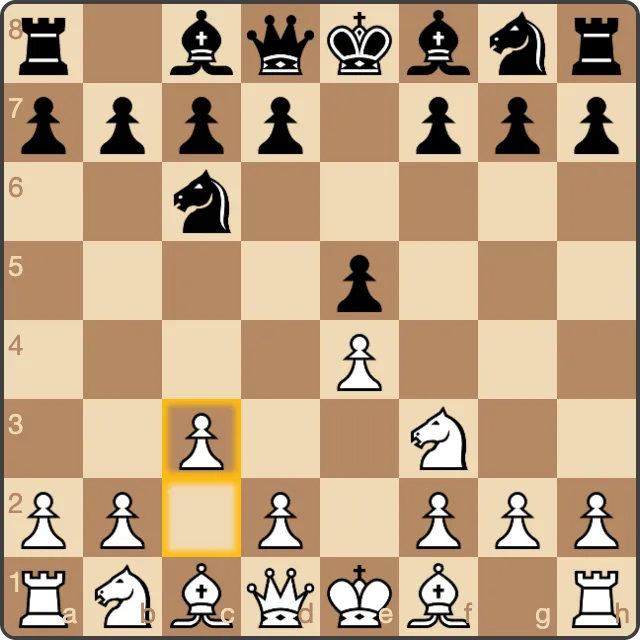
The Ponziani Opening arises after the following moves:
1.e4 e5 2.Nf3 Nc6 3.c3
In this sequence, White prepares to challenge Black's central pawn on e5 by planning to advance d4. This setup aims to establish a strong pawn presence in the center, which is a cornerstone of effective chess strategy.
Objectives of the Ponziani Opening
- Central Control: By preparing d4, White seeks to dominate the center, restricting Black's piece mobility and opening lines for further development.
- Piece Development: The opening encourages rapid development of knights and bishops, facilitating early castling and ensuring king safety.
- Flexibility: The Ponziani offers multiple plans and can transpose into various other openings, making it a versatile choice.
Main Lines of the Ponziani Opening
After 3.c3, Black has several viable responses, each leading to distinct types of positions and strategic battles.
The Ponziani Opening: 3...Nf6
One of Black's most common replies to 3.c3 is 3...Nf6. This natural move seems harmless, but it opens the door to the famous Ponziani trap.
1.e4 e5 2.Nf3 Nc6 3.c3 Nf6
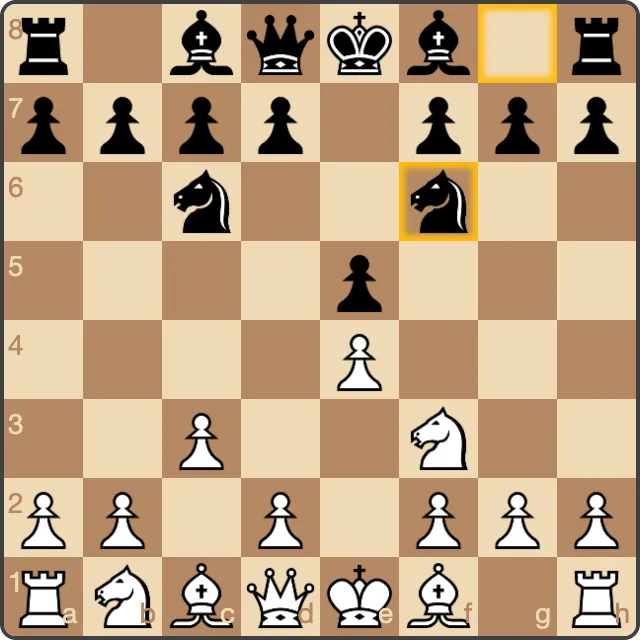
4.d4 Nxe4 5.d5 Ne7 6.Nxe5 Ng6


7.Qd4 Qf6 8.Qxe4 Qxe5 9.Qxe5 Nxe5 10.Be3 b6
Even if the game transitions to an early endgame, White holds the advantage thanks to superior piece activity and better control of the center.
The Ponziani Opening: 3...d5
Another solid response for Black is to challenge the center with 3...d5.
1.e4 e5 2.Nf3 Nc6 3.c3 d5 4.Qa4 f6
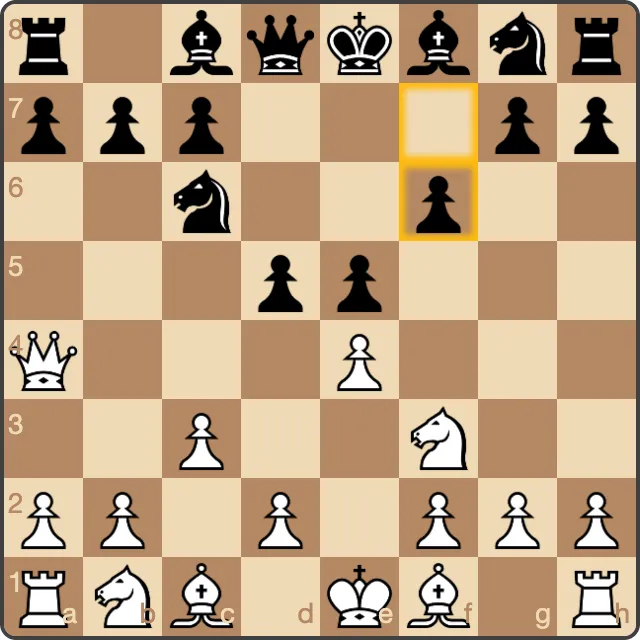
In this position, White's 4.Qa4 puts immediate pressure on Black's center. Black may opt for the safe route with 4...f6, or more ambitiously with the gambit-like 4...Bd7.
1.e4 e5 2.Nf3 Nc6 3.c3 d5 4.Qa4 Bd7 5.exd5 Nd4 6.Qd1 Nxf3+ 7.Qxf3 Nf6 8.Bc4 e4 9.Qe2 Bd6 10.d4 0-0
In both lines, White maintains solid attacking chances while Black struggles to justify the pawn sacrifice.
The Ponziani Opening: 3...d6
If Black adopts a more cautious approach with 3...d6, the game can transpose into quieter lines.
1.e4 e5 2.Nf3 Nc6 3.c3 d6 4.d4 Be7
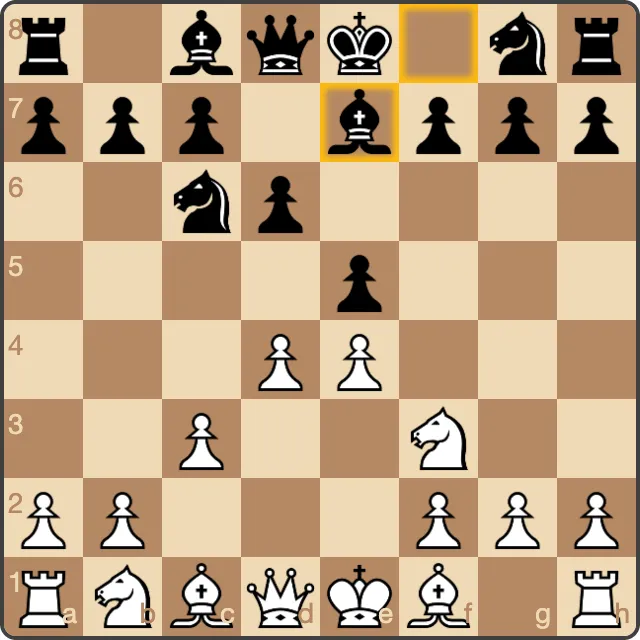
White can comfortably develop with moves like Bd3, h3, 0-0, Nbd2-f1-g3, and Be3. These solid moves allow White to retain the initiative without facing any real pressure from Black.
The Ponziani with 4...Nxe4
One of the more challenging lines occurs when Black grabs the pawn with 4...Nxe4.
1.e4 e5 2.Nf3 Nc6 3.c3 Nf6 4.d4 Nxe4 5.d5 Ne7 6.Nxe5 Ng6
From here, White has several options, including 7.Bd3 to set a trap, or the more positional 7.Qd4, leading to a favorable endgame for White with a space advantage on the queenside. For tactical players, 7.Qf3 is another promising alternative, keeping the focus on dynamic play.
Strengths and Weaknesses of the Ponziani
While the Ponziani Opening may not be as commonly seen in top-level play, it has several strategic benefits and drawbacks:
Strengths:
- Central Control: The Ponziani allows White to establish a strong center, especially with a d4 push, making it harder for Black to develop freely.
- Flexibility: White has multiple avenues for development, especially in terms of pawn structure and piece placement, making it versatile against various Black responses.
- Element of Surprise: Due to its rarity, Black players are often unfamiliar with the main variations, which can lead to mistakes and missed opportunities.
Weaknesses:
- Potential Developmental Drawbacks: The move c3 can delay White's queenside knight from reaching its ideal development square at c3.
- Sharp Counterattacks from Black: If White is not cautious, Black can seize the initiative with an unexpected move like 3...f5, leading to complex tactical play that may favor the better-prepared player.
Sample Game: Exploring the Depth of the Ponziani
Here's an example of how a typical Ponziani game might unfold in the 3...Nf6 variation:
1.e4 e5 2.Nf3 Nc6 3.c3 Nf6 4.d4 Nxe4 5.d5 Ne7 6.Nxe5 Ng6 7.Qd4 Qf6 8.Qxe4 Qxe5 9.Qxe5+ Nxe5 10.Nd2 d6 11.Nc4 Nxc4 12.Bxc4 Be7
In this game, White achieves a solid position by emphasizing central control and simplifying into a favorable endgame. The position demonstrates the strategic strength of the Ponziani Opening when executed with precision.
The Ponziani Opening provides a fascinating blend of classical strategy and tactical opportunities, ideal for players looking to add depth and variety to their game. Its unique structure, stemming from c3 and the possibility of d4, allows White to set traps and control the center while keeping options open for flexible development. Though it may lack popularity in high-level tournaments, the Ponziani remains a valuable asset for players who thrive on surprise and tactical complexity. With careful study and understanding of its main variations, the Ponziani can become a powerful weapon in any chess player's arsenal.
Model Games